Behaviour and Rewards
At Silverdale, we are committed to creating a calm, purposeful and inclusive environment where every student can thrive. Our behaviour culture is built around our core values of Ambition, Belonging and Integrity, providing clear, consistent expectations that help students achieve their very best both academically and personally.
We believe that positive behaviour is developed through strong relationships, excellent teaching, clear routines and a shared commitment to high standards. Our focus is always on recognising and celebrating success, supporting students to make positive choices and providing timely intervention when difficulties arise.
Behaviour at Silverdale is supported through a strong pastoral network. Form Tutors, Key Stage Teams, the Inclusion Team and Senior Leaders work closely with students and families to provide guidance, encouragement and support, ensuring that every young person has the opportunity to succeed.
We know that strong partnerships between home and school are essential. By working together with parents and carers, we can celebrate achievements, communicate effectively and provide the support needed for students to meet our expectations and reach their potential.
At the heart of our approach is a commitment to ensuring that everyone feels safe, valued and respected. Silverdale operates a zero-tolerance approach to bullying, discrimination, harassment and prejudiced behaviour, and we are dedicated to fostering a culture where every member of our community feels a genuine sense of belonging.
Further information can be found in our Behaviour for Learning Procedure, available to download from our policies page.
Our Culture Code
At Silverdale, culture matters. We believe every young person can succeed when expectations are clear, support is strong and relationships are built on mutual respect. Through our Culture Code we aim to create a school environment that is calm, inclusive, ambitious and focused on success for all.
The Silverdale Culture Code provides a shared framework for how we learn, behave and treat one another. It is built around three core values that underpin all aspects of school life.
Ambition
Striving to be the very best version of ourselves every day.
Belonging
Creating a community where everyone feels welcomed, valued and supported.
Integrity
Doing the right thing, even when nobody is watching.
These values provide a common language for students, staff and families and help shape our positive school culture.
In Lesson – Student Commitments
To support high-quality learning in every classroom, students are expected to follow our six Student Commitments.
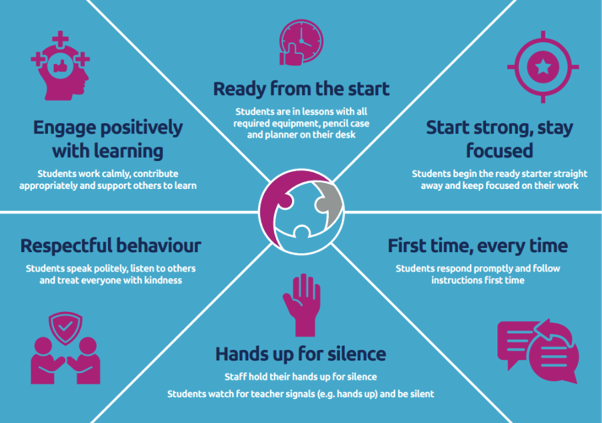
Ready from the Start: Arrive with all required equipment, including a planner and pencil case, and be ready to learn immediately.
Start Strong, Stay Focused: Begin learning activities promptly and remain focused throughout the lesson.
First Time, Every Time: Follow instructions promptly and respond positively to staff guidance.
Hands Up for Silence: Recognise and respond immediately to staff signals for silence and attention.
Respectful Behaviour: Speak politely, listen carefully and treat others with kindness and respect.
Engage Positively with Learning: Contribute appropriately, work calmly and support others in their learning.
Out of Lessons - STEP: Expectations Around School
We know that social times, corridors and transitions are equally important in shaping students' experiences of school. Positive behaviour extends beyond the classroom. As a school, we use STEP as a structure to provide a simple guide to how students are expected to conduct themselves around the school site.
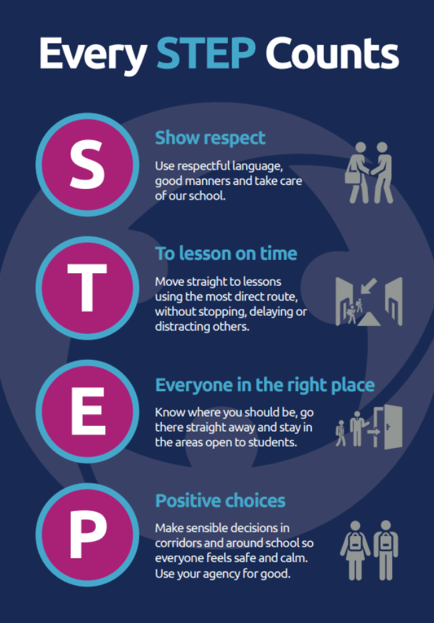
S - Show Respect
Use respectful language, demonstrate good manners and take pride in the school environment.
T - To Lesson on Time
Move directly to lessons using the most efficient route and avoid unnecessary delays.
E - Everyone in the Right Place
Know where you should be and remain in designated student areas.
P - Positive Choices
Make sensible decisions that contribute to a calm, safe and welcoming environment for everyone.
The Culture Card
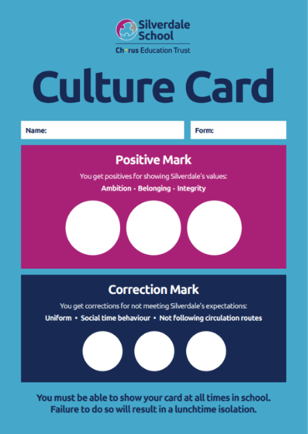 All students use a Culture Card throughout the school day to support the expectations of the Culture Code and STEP. Staff actively reward positive choices, kindness, responsibility and contributions to the school community. The Culture Card helps us recognise the behaviours we want to see more often while ensuring a fair and consistent approach to addressing poor choices.
Students can earn positive marks for demonstrating Ambition, Belonging and Integrity. Consistent positive contributions are recognised and celebrated. Where students receive repeated corrections before positive marks, further consequences may be applied.
The Culture Card is used to:
- Recognise and celebrate students who consistently demonstrate Ambition, Belonging and Integrity.
- Provide clear and consistent feedback when expectations are not met.
Behaviour and Consequences
At Silverdale, we believe that positive behaviour is best promoted through strong relationships, engaging lessons, clear routines and high expectations. Staff actively recognise and reward students who demonstrate our values of Ambition, Belonging and Integrity, and positive interactions always outweigh consequences. When behaviour falls below expectations, it is addressed consistently, fairly and promptly so that students can reflect, learn and move forward positively.
The Sanction Ladder
To support students in making positive choices, staff use a simple and consistent Warning → Sanction → Remove process in lessons.
Warning
A warning is issued when a student does not meet the Student Commitments. Staff will clearly explain the concern and provide the student with the opportunity to correct their behaviour and re-engage positively with learning.
S1 Detention (10 Minutes)
If the behaviour continues, a sanction is issued. This results in a same-day 10-minute after-school detention and a correction point being recorded. Students are expected to reflect on their choices and return to learning successfully.
S2 Remove Room (20 Minutes)
If the behaviour continues after an S1 sanction, the student may be removed from the lesson by On-Call staff and placed in a Remove Room. A further correction is recorded and the student receives a 20-minute after-school detention.
Reflect Base
For more serious incidents, failure to attend detention, repeated disruption, or behaviour that requires further investigation, students may be placed in the Reflect Base for part of a day or a full day. This provides a structured environment where students can continue their learning while reflecting on their behaviour and receiving additional support.
Same-Day Detentions
Silverdale operates a same-day detention system because consequences are most effective when they are closely linked to the behaviour that prompted them. This approach helps students reflect on their actions, take responsibility and make positive changes more quickly. Parents and carers are informed through Arbor when detentions are issued.
Why Same-Day Detentions?
Research and feedback have shown that consequences are most effective when they take place as close as possible to the behaviour that prompted them.
This approach helps students to:
- Reflect on behaviour while events are still fresh in their minds.
- Learn from mistakes more effectively.
- Engage in restorative conversations where appropriate.
- Develop responsibility and self-regulation.
- Make positive changes more quickly.
Where a detention is issued, students will be expected to remain after school on the same day. Our aim is to support
Serious Incidents
In cases involving serious incidents, such as aggressive behaviour, bullying, discrimination, dangerous behaviour, theft, smoking, fighting or unacceptable use of technology, sanctions may be escalated immediately. Depending on the nature of the incident, outcomes may include placement in the Reflect Base, suspension or, in the most serious cases, permanent exclusion.
Attendance and Punctuality
At Silverdale, we believe that excellent attendance and punctuality are essential for success. Arriving on time and being ready to learn helps students make the most of every lesson and contributes to a calm, purposeful learning environment.
Students should arrive on the school site before 8:55am and are expected to attend all lessons punctually throughout the day. Being on time demonstrates integrity, respect for others and a commitment to learning.
We actively recognise and reward students who demonstrate excellent attendance and punctuality, celebrating those who consistently meet our expectations. Regular attendance and punctuality contribute to our rewards programme and help students achieve their full potential.
Where students arrive late to school or lessons, sanctions may be issued in line with our Behaviour for Learning Procedure. Our aim is to support students in developing positive habits that will help them succeed both at school and beyond.
Mobile Phones and Electronic Devices
Mobile Phone Expectations
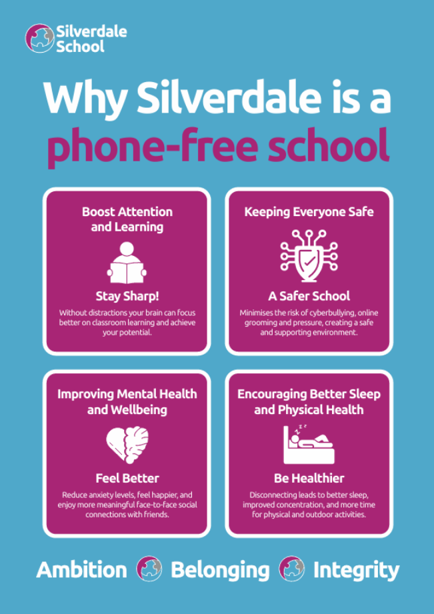 At Silverdale, we are committed to creating a calm, focused and purposeful learning environment where every student can thrive. To support learning, wellbeing and positive relationships, students in Years 7 to 11 are not permitted to use mobile phones during the school day.
Students must switch their phones off and place them in their bags before entering the school site. Phones must remain switched off and out of sight throughout the school day, including during lessons, lesson changeovers, breaktimes and lunchtimes. If a mobile phone is confiscated, the student will receive a detention as a consequence, and the device will be confiscated in accordance with the school policy.
Why Do We Have This Rule?
Our approach is rooted in our values of Ambition, Belonging and Integrity. Limiting access to mobile phones during the school day helps students to:
- Focus fully on learning and achievement.
- Build positive face-to-face relationships with peers and staff.
- Reduce distractions and improve concentration.
- Support positive mental wellbeing.
- Demonstrate responsible and respectful behaviour.
What Happens if a Phone Is Seen or Used?
If a mobile phone is taken out during the school day, it will be confiscated, parents/carers will be informed and a behaviour point will be issued. Repeated incidents will result in escalating sanctions in line with the school's Behaviour for Learning procedures.
Students who repeatedly breach the mobile phone expectations may be required to hand their phone into the Key Stage Office at the start of each day for a specified period.
Refusal to Hand Over a Phone
Refusal to hand over a mobile phone when requested by a member of staff will be treated as defiance and sanctioned accordingly.
Online Conduct and Mobile Technology
We expect all students to use technology responsibly. The school will not tolerate:
- Taking photographs or videos without consent.
- Filming students or staff without permission.
- Cyberbullying or targeting individuals through group chats.
- Sharing inappropriate, offensive, discriminatory or harmful content.
- Harassment or intimidation through social media or messaging platforms.
Serious incidents involving mobile technology may result in more significant sanctions, including suspension where appropriate.
Medical Exemptions
We recognise that some students require smartphone technology to support medical conditions, such as diabetes monitoring. In these circumstances, students may be authorised to use a device in line with an agreed support plan and carry a permit confirming this arrangement.
Sixth Form Students
Sixth Form students may bring mobile phones to school and use them in designated Sixth Form areas. As part of preparing students for higher education, employment and adult life, we encourage responsible and appropriate use of technology, helping students develop the digital awareness, independence and self-regulation skills needed to use mobile devices safely and effectively. However, mobile phones should not be used on corridors, in dining areas or in other non-designated spaces.
Our Commitment
By maintaining a phone-free environment for Years 7 to 11, we support students to engage fully in school life, strengthen relationships, maximise learning opportunities and contribute positively to our school community.
Confiscation of personal items in school
Please note that any personal items that contravene school rules are brought into school at the owner's risk. Any damage to these items will not be paid for by the school. Silverdale School does not allow students to use mobile phones while in school. They should be turned off in the students' bags before entry to school. They will be confiscated and taken to the relevant key stage office. If this happens repeatedly for a student, the school will expect the parent/carer to come to collect it.
Rewards
Positive comments, positive interactions, praise and rewards must outweigh consequences.
Rewards at Silverdale School are:
- Fair: students systematically receive weekly rewards for attendance, punctuality and positive behaviour. Thusly, students are constantly recognised for ‘getting it right’ every day and every week. All students who deserve reward are rewarded. For those who go beyond the expectations, they will receive an additional reward, but this will be appropriate.
- Consistent: rewards are given for all aspects of school life and are given consistently by all staff.
- Simple: what is rewarded is clear and follows consistent criteria.
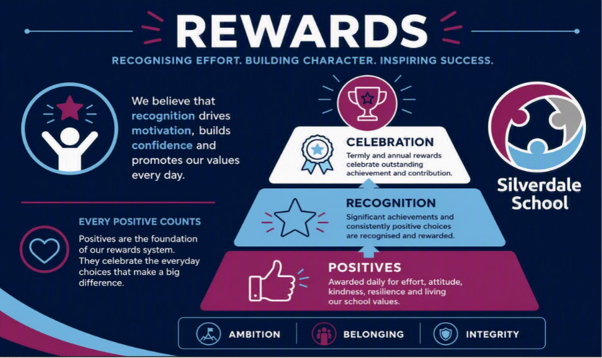
Teaching staff can reward students in the following ways:
- Verbal praise.
- Comments on work.
- Certificates and postcards.
- Sending students to the Year Team/Senior Leadership Team for praise and recognition in the terms of ‘shout outs’.
- Positive contact with home.
- Public display of work.
- Acknowledgement through assembly.
- Student of the week.
- Certificate/award at presentation evening.
- Awarding Positive points in lessons.
Positives
All students are systematically awarded commendations for meeting the Silverdale School expectations. Students receive five positive points weekly for each of the following:
- 100% attendance.
- No late marks.
- No behaviour points.
Students receive commendations for each extracurricular club attendance.
Rewards for accruing positives
Students are systematically rewarded for accruing positives as follows:
- The top 4 students in each year group each week receive a queue-jump pass for the following week.
- One student each week is chosen by their form tutor as student of the week.
- Certificates are awarded each half-term for the number of accrued points. These range from bronze award, silver award, gold award, to platinum award.
Bullying
We are committed to developing a culture of inclusion, tolerance and respect in order to encourage mutually supportive students at Silverdale School.
All bullying is unacceptable, regardless of who bullies, how it is delivered or what reasons are given to justify it.
Bullying hurts. No one deserves to be a victim of bullying. Bullying has the potential to damage the mental health of a victim.
We realise that people who are bullied do not always show their hurt and speak about it. If students know someone is being bullied, they must tell a teacher.
Signs and symptoms that someone is being bullied
- Is frightened of walking to or from school.
- Doesn’t want to go on the school/public bus.
- Begs to be driven to school.
- Changes their usual routine.
- Is unwilling to go to school (school phobic).
- Begins to truant.
- Becomes withdrawn, anxious, or lacking in confidence.
- Attempts or threatens suicide or runs away.
- Cries themselves to sleep at night or has nightmares.
- Feels ill in the mornings.
- Begins to do poorly in school work.
- Comes home with clothes torn or books damaged.
- Has possessions which are damaged or ‘go missing’.
- Asks for money or starts stealing money (to pay bully)
- Has dinner or other monies continually ‘lost’.
- Has unexplained cuts or bruises.
- Comes home starving (money/lunch has been stolen).
- Becomes aggressive, disruptive or unreasonable.
- Is bullying other children or siblings.
- Stops eating.
- Is frightened to say what’s wrong.
- Gives improbable excuses for any of the above.
- Is afraid to use the internet or mobile phone.
- Is nervous or jumpy when a cyber-message is received.
These signs and behaviours could indicate other problems, but bullying should be considered a possibility and should be investigated.
If a parent suspects their child is being bullied they should report their concern to the form tutor or head of year so that we can investigate. It is important that parents advise their child not to fight back; it can make it worse. Parents/carers must help us ensure we have a culture of tolerance and respect at school by promoting this at home.
Bullying directly impacts on the emotional wellbeing of students, and we will ensure that any reports of bullying are dealt with in accordance with the anti-bullying policy (available via the policies page).
Silverdale will aim to ensure that support is in place for the victims of those who have been bullied and that they are supported with their emotional wellbeing and to promote positive wellbeing and building resilience. Whilst we will discipline those that bully others, we will also offer to help them to change their behaviour.
Help organisations
- National Bullying Helpline: 0845 22 55 787
- Child Exploitation And Online Protection (CEOP): 08700 000 33 44
- Kidscape Parents' Helpline (Monday – Friday, 10am – 4pm): 0845 1205204
- Parenting and Family Support
- Childline: 0800 1111