Teaching and Learning
At Silverdale, we are committed to providing a broad and ambitious education for every student.
We believe that high-quality teaching is the foundation of inclusion. Whatever their background, starting point or individual needs, every student should be able to access, participate in and succeed in learning.
Our approach is built around three important ideas:
- Expert Knowledge – teachers understand their students, their subject, the curriculum and how students learn.
- Supportive Environment – classrooms are characterised by positive relationships, clear routines, high expectations and a culture where all students can thrive.
- Maximising Learning – teachers use effective teaching approaches, check students' understanding and respond to what they need.
At Silverdale, these principles are brought together through our Teaching Model, responsive teaching, consistent classroom routines and Foundational Learning.
The Silverdale Teaching Model
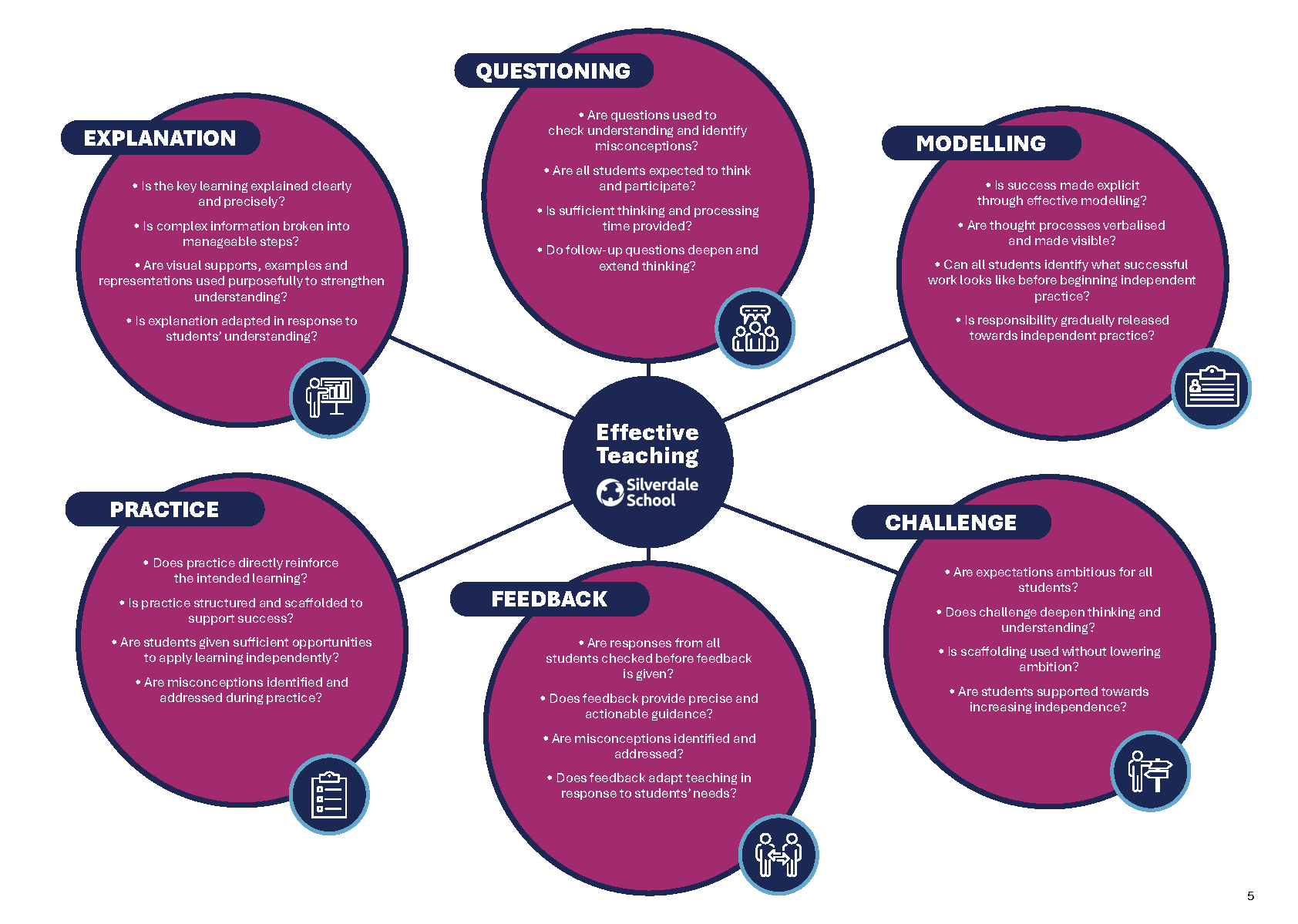
Our Teaching Model provides a shared understanding of effective teaching at Silverdale. It reflects our values of Ambition, Belonging and Integrity and our commitment to excellent learning for all.
These are the instructional tools our teachers draw upon to support learning.
What does this mean for my child?
In lessons, students should experience:
- clear explanations that connect new learning to what they already know;
- modelling that makes successful work and thinking visible;
- questioning that makes students think and helps teachers check understanding;
- practice that helps students remember, apply and become increasingly independent;
- feedback that identifies misconceptions and helps students improve;
- challenge and high expectations, alongside appropriate support to succeed.
This does not mean every lesson looks the same. Teachers use their professional expertise to select the approaches that best suit their subject, the learning and the students in front of them.
Responsive Teaching
An important part of excellent teaching at Silverdale is responsive teaching.
Teachers regularly check what students know and understand through questioning, discussion, practice, observation and students' work. They then use this information to decide what needs to happen next.
This might mean revisiting an idea, correcting a misconception, giving another example, explaining something differently, providing further practice or increasing the level of challenge.
High Expectations and Inclusion
At Silverdale, high expectations and inclusion go together.
We want every student to experience an ambitious curriculum. Where students encounter barriers, teachers work to identify and remove them while maintaining high expectations.
Support might include clear modelling, breaking complex learning into manageable steps, carefully chosen examples, vocabulary support, guided practice or scaffolding.
The aim is to give students the support they need to succeed and become increasingly independent, without lowering ambition.
Foundational Learning
Strong foundations help students access increasingly challenging learning across the curriculum.
Our Foundational Learning priority focuses on:
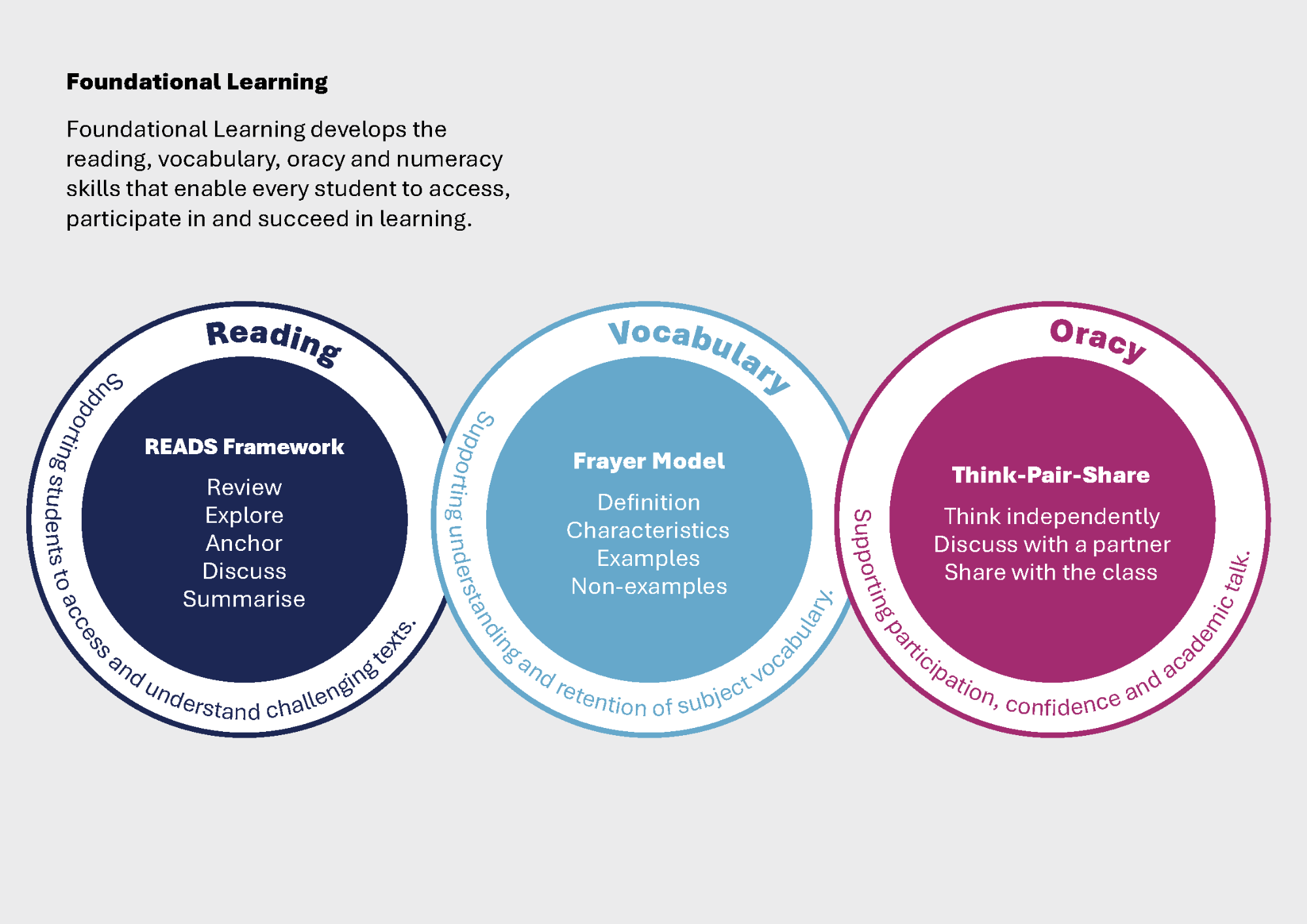
These skills are developed through high-quality teaching across the curriculum. We also have shared approaches to support them.
READS
READS is our shared approach to supporting reading across the curriculum:
Recall – Explore – Anchor – Discuss – Summarise
It helps students access challenging texts by connecting to prior knowledge, exploring vocabulary, checking understanding, discussing ideas and summarising key learning.
Frayer Model
The Frayer Model supports the explicit teaching of important subject vocabulary. Students explore a word through its definition, characteristics, examples and non-examples, helping them develop a deeper understanding and use new vocabulary confidently.
Think–Pair–Share
Think–Pair–Share is our agreed approach to purposeful classroom talk. Students think independently, discuss their ideas with a partner and then share their thinking. This helps all students participate, develop vocabulary and deepen their thinking before answering or writing.
These approaches provide familiar strategies across school, while teachers decide when and how they are most appropriate within their subject.
Feedback that Moves Learning Forward
At Silverdale, feedback is about improving learning, not simply marking work.
Feedback may be verbal, written, live, whole-class, peer or self-assessment. What matters is that it identifies misconceptions, strengthens understanding and helps students know what to do next.
Students use green pen to respond to feedback, making corrections and improvements visible. Our PROUD expectations establish consistent standards for the presentation and organisation of students' work.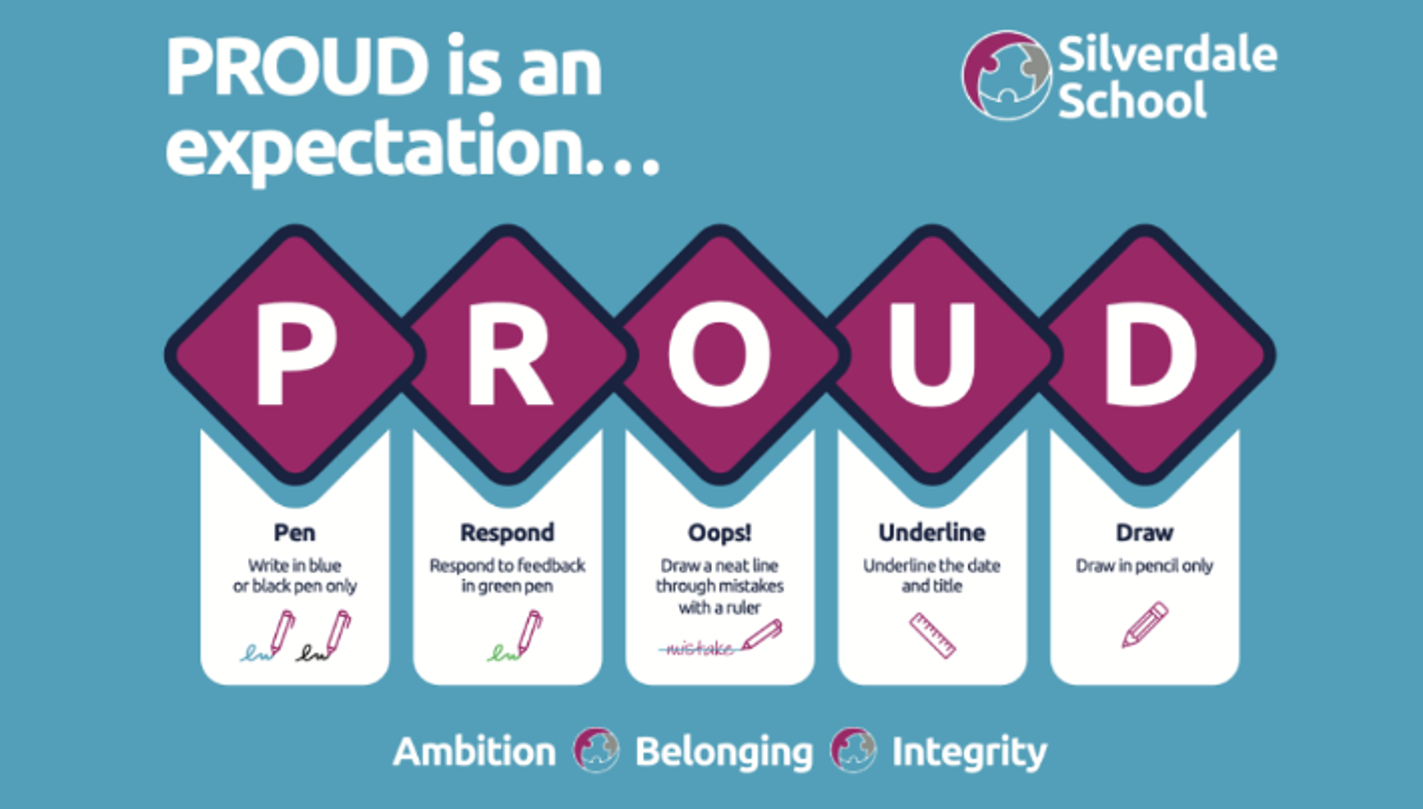
Different subjects may use different approaches to feedback. We do not expect a particular quantity of written marking; our focus is on the impact feedback has on learning.
Consistent Classrooms
Students learn best in classrooms that are safe, supportive, purposeful and predictable.
Clear and consistently applied routines mean students spend less time working out what to do, and more time focused on learning.
Staff and students therefore have shared commitments around the start and end of lessons, equipment, ready starters, gaining attention, positive engagement and behaviour.
Consistency does not mean every teacher teaches in the same way. It provides a common foundation that protects learning time and allows teachers to focus on helping students learn.
Evidence-Informed Teaching and Professional Learning
At Silverdale, our approach is evidence-informed, drawing on current educational research, professional expertise and a strong understanding of how students learn.
Teachers consider how students build on prior knowledge, how memory and cognitive load affect learning, and how approaches such as modelling, practice, retrieval and checking for understanding can support secure and lasting learning.
Excellent teaching also develops through professional learning, reflection and collaboration. Our ongoing CPD programme reflects the needs of our students and whole-school priorities. Teachers share effective practice and learn from one another within departments and across the school.
Alongside this shared approach, we place a strong emphasis on professional trust and teacher autonomy. Our Teaching Model provides common principles and language; it is not a prescribed lesson structure. Teachers are trusted as experts to make professional decisions about how best to teach their subject and respond to their students.
School leaders work with colleagues to develop practice through professional dialogue, collaboration and reflection. Our aim is continuous improvement rather than uniformity: a shared understanding of effective teaching, combined with the expertise to apply it appropriately in different subjects and classrooms.